Audrey Huret
Research Interests
Catalysis for functional and sustainable polymers
Keywords: ROP, organocatalysis, bio-based polymer, cyclodextrin, (poly)saccharide, nucleobase, supramolecular chemistry, biocatalysis, lipase
Organocatalysis for the ring-opening polymerisation (ROP) of cyclic esters
The development and use of biodegradable polyesters, particularly those derived from renewable resources, have attracted considerable interest in recent years, given their wide range of applications, notably in the biomedical and food packaging sectors. Conventional polymerisation methods using metals can result in the presence of trace amounts of residual metals in the final material, which may be harmful depending on the intended applications. The use of organic catalysis or biocatalysis may offer an alternative way of overcoming these drawbacks.
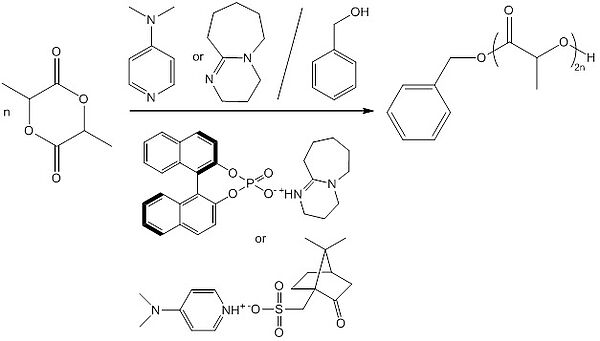
With this in mind, we have demonstrated that the use of phosphoric acid derivatives (binaphthyl-diyl hydrogen phosphate) as catalysts enables ring-opening-controlled polymerisation (ROP) of lactones under mild reaction conditions, on the one hand, and of lactide, on the other, through the use of acid–base pairs.
Functionalisation and grafting of polysaccharides
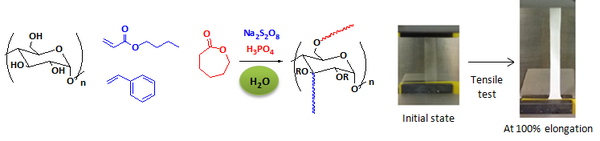
Similarly, we have shown that it is possible to polymerise e-caprolactone quantitatively in water using various Brønsted acids (phosphoric, methanesulphonic or p-toluenesulphonic acids) as organocatalysts. This innovative approach enables the preparation, in the presence of water-soluble polysaccharides, in a single step and under mild conditions, of poly(e-caprolactone)-grafted-dextran and poly(e-caprolactone)-grafted-methylcellulose copolymers.
Based on these results, research has led to the development of thermoplastic resins through copolymerisation via a single-step dual functionalisation of starch, yielding highly stretchable materials (IFMAS thesis, Société Roquette Frères collaboration).
The grafting of polymer on cellulose nanocrystals lies also in our interests.
Organocatalysis for the functionalisation of polyesters with saccharide derivatives
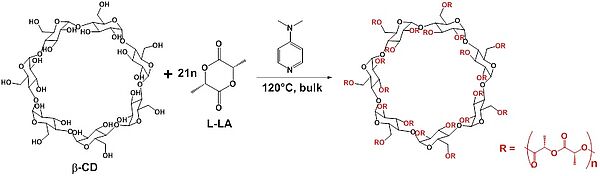
The organocatalysed functionalisation of aliphatic polyesters using saccharide derivatives (monosaccharides and native or modified cyclodextrins) is another key area of research being conducted by our team. The advantage of such functionalisation is that it provides access to a wide variety of polymer structures – namely, the production of linear or so-called ‘star-shaped’ functionalised polymers – whilst also allowing the properties of the synthesised polymers to be tailored according to various parameters (degree of polymerisation, number of branches, nature of the branches, etc.), all whilst maintaining biocompatibility. Under these conditions, it has been demonstrated that functionalisation occurs quantitatively (full monomer conversion) and in a controlled way (initiation of all hydroxyl groups regardless of their reactivity). The macromolecular structures thus obtained have shown promising potential, for example, as nucleating agents for the crystallisation of PLA (collaboration with the Lab of Prof. S. Chirachanchai, Chulalongkorn University, Bangkok, Thailand) and for the delivery of active ingredients (collaboration with the Lab of Dr A. Valente, University of Lisbon, Portugal).


As research continued, studies were carried out to investigate the influence of the saccharide moiety on the intrinsic properties of the polymer, in particular its mechanical properties (study of the relationship between structure and mechanical properties) (thesis co-supervised by Prof. M. Brieu of the Lille Mechanics Laboratory (Centrale Lille) and co-supervised by Prof. S. Paul of the UCCS VALBIO/Realcat team).
Functionnalisation with Nucleobases
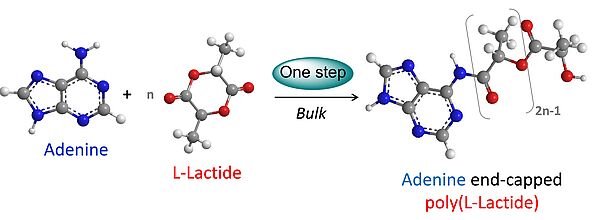
Nucleobase-functionalised polymers are widely used in the fields of supramolecular chemistry and self-assembly, and their development for biomedical applications is also an area of particular interest. These polymers are generally synthesised using lengthy and tedious multi-step procedures. We have recently demonstrated that L-lactide can be polymerised quantitatively in the presence of adenine, a molecule of biological interest, which acts as both an organoinitiator and an organocatalyst. The reaction conditions, involving short reaction times and relatively low temperatures, enable the synthesis of polymers functionalised at the chain ends with adenine via a simple, single-step procedure, without the use of solvents or catalysts, which holds promise for biomedical applications. A comprehensive study of the reaction and its mechanism has been carried out, and DFT calculations have shown that the polymerisation occurs via hydrogen-bond catalysis. (Group of Dr A. Valente, University of Lisbon, Portugal).
Polycondensation of (new) biobased monomers
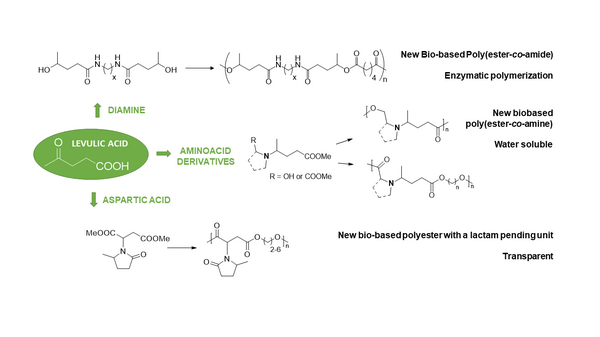
We have designed three libraries of new monomers based on levulinic acid, a promising biobased building block avalaible from the hydrolysis of polysaccharides. The polycondensation of these new monomers lead to new types of specialties polymer, e.g poly(ester-co-amide), poly(ester-co-amine) and polyester bearing a pendant lactam group.